
“I’m tired” is one of the most under-translated sentences in the human language.
It sounds like a physical complaint.
Most of the time, it isn’t.
In clinical work, I’ve learned to hear it as a portal, not a conclusion. What’s behind it is often far more complex than fatigue.
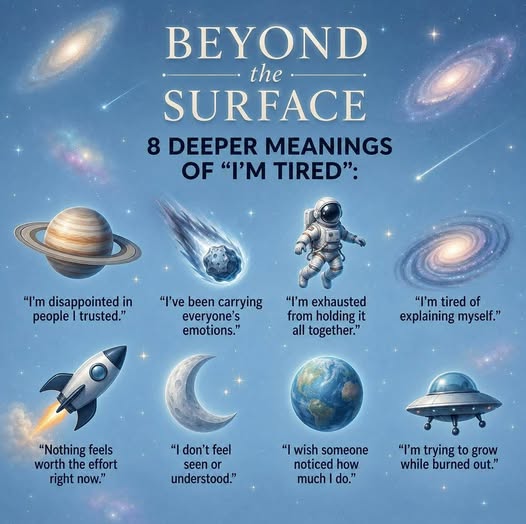
Here are 8 things “I’m tired” can actually mean:
 “I’ve been carrying other people’s emotions for too long.”
When you become the person everyone leans on emotionally, exhaustion stops being physical. Your nervous system becomes a resource others unconsciously use.
“I’m exhausted from constantly reading the room.”
Hypervigilance is invisible. It looks like attentiveness. But internally, it feels like a background process that never shuts off.
“I’ve been holding it together for everyone else.”
The people who seem strongest are often the least supported. Containment has a cost. Sometimes “I’m fine” becomes a form of survival.
“I’m disappointed by people I thought I could trust.”
Some exhaustion is actually grief. Relational disappointment drains energy in ways sleep cannot repair.
“I’m worn down from constantly having to justify myself.”
The exhaustion isn’t always caused by one moment. It’s the accumulation of years spent proving your worth, your intentions, your sensitivity, your place.
“Nothing feels worth the effort right now.”
This is not laziness. Often, it’s what helplessness sounds like internally — when repeated effort stopped leading to change, the mind slowly stops generating motivation.
“I wish someone would notice without me having to ask.”
There’s a particular loneliness in being perceived as capable all the time. Competence often hides unmet needs.
“I’m trying to grow while running on empty.”
Growth requires energy. Healing requires energy. Change requires energy. Rest is not the opposite of progress — it’s one of the conditions that makes progress possible.
The next time someone tells you they’re tired — or you notice it in yourself — don’t move past it too quickly.
Ask what kind of tired.
The answer is usually more precise than the word itself.
Tks dr. Federico Riccardo Rossi psicologo